

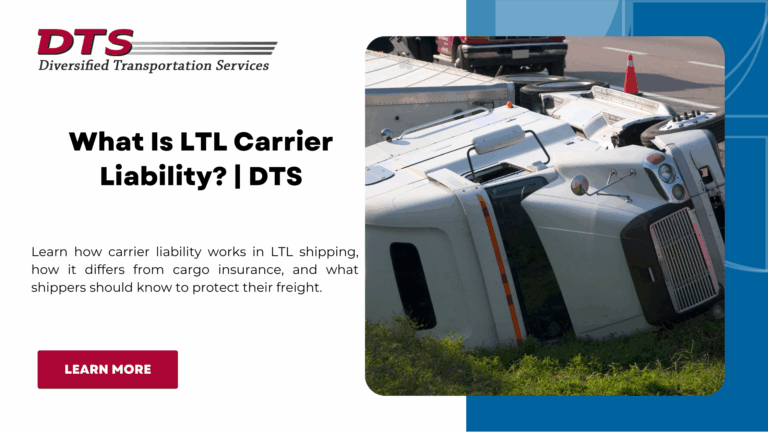
Shipping can be risky business. Freight can be damaged, lost, or even stolen, and recent reports indicate that cargo theft accounts for losses of around $1 billion per year.
This can be a particular concern for businesses using less-than-truckload (LTL) shipping.
LTL shipping consolidates multiple freight shipments into one, with items from different businesses sharing space in a trailer. As a result, freight makes multiple stops and changes hands several times on the road, creating more opportunities for damage, loss, or theft.
Do shippers lose money if any of these issues affect their shipments? Not necessarily. Carriers offer some coverage to reassure customers, but it’s usually limited.
That’s why you need to understand carrier liability before you use an LTL shipping service.
Below, we’ll explain how LTL carrier liability works, why it’s so important to businesses, and why it’s not the same as cargo insurance.
LTL carrier liability refers to the financial responsibility that a carrier has for in-transit shipment damage or loss. But carriers have liability limits, and the coverage offered is usually outlined in the Bill of Lading.
These limits are based on the National Motor Freight Classification (NMFC) freight class of the goods being shipped. Freight class ranges from 50 to 500 and is determined by the four key characteristics of a shipment:
However, standard carrier liability often doesn’t cover a shipment’s full value, so it’s crucial to check the carrier’s liability terms and conditions to find out if you need extra insurance.
Carrier liability may be limited, but it still provides businesses with a basic safety net. Specifically, it helps cover part of the cost if shipments are damaged or go missing due to negligence. Liability also encourages carriers to handle freight responsibly at all times and avoid shippers filing claims.
However, you should be aware of liability limitations before you use an LTL shipping service. These include:
Unfortunately, businesses may assume they’re fully covered if they’re unaware of these limitations. And that can lead to expensive surprises if something goes wrong.
At first glance, it might seem like LTL carrier liability and cargo insurance are the same. However, there are key differences between carrier liability vs. cargo insurance that you should be aware of. Understanding these will help you make the right choice for your shipment coverage.
LTL carrier liability provides shippers with some protection, but coverage is limited and not as comprehensive as cargo insurance.
To avoid expensive surprises, it’s important to understand what’s covered under carrier liability and where gaps may exist. DTS can help you navigate liability coverage and choose the right coverage and insurance for your cargo. Get in touch with our professionals today for personalized logistics advice.
Whether you're a company looking to improve one facet of your supply chain, your entire supply chain, or simply looking for a transportation and logistics consultation, we can help.

19829 Hamilton Avenue
Torrance, CA 90502